
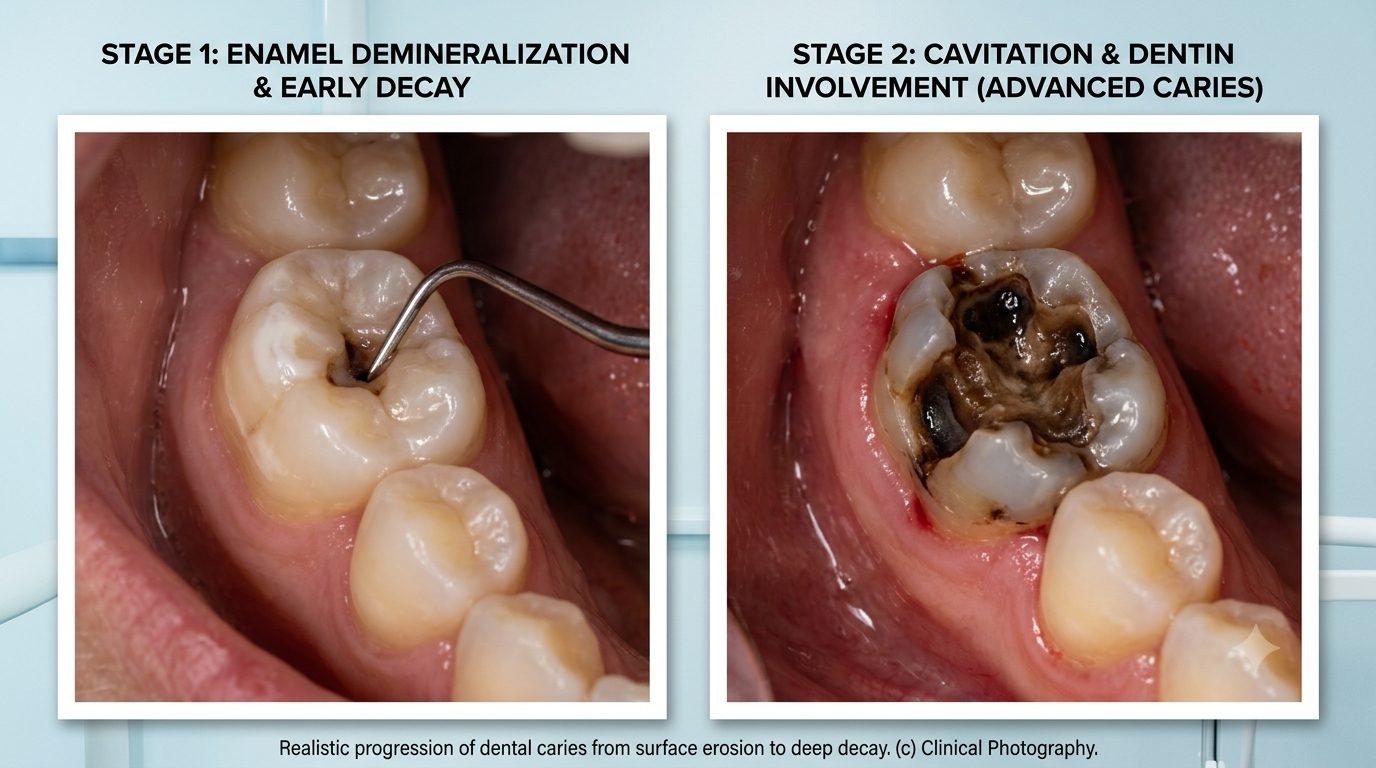
In short: Only at the very earliest stage. A tiny “white spot” where enamel has just begun to weaken can sometimes be re-hardened with fluoride and good care before a hole forms. But once decay has broken through into a cavity (a hole), it cannot heal itself and needs a filling — the sooner, the simpler.
This is an important one to get right, because the answer changes completely depending on how far the decay has gone.
The earliest stage — yes, it can be reversed. Before an actual hole forms, decay begins as a “white spot” where acid has started to leach minerals out of the enamel. At this stage the enamel is weakened but still intact, and it can often be re-hardened (remineralised) — using fluoride toothpaste or a professional fluoride treatment, cutting down sugar, and cleaning well. Caught here, no filling is needed.
Once a cavity (a hole) has formed — no, it cannot heal. When the decay breaks through the enamel surface and creates a physical hole, the tooth structure is lost for good. Enamel has no living cells to regrow, so the cavity won’t repair itself and will only get bigger, deeper and eventually painful. It needs a filling to clean out the decay and seal the tooth. Waiting doesn’t help — a small filling today prevents a bigger filling, or a root canal, later.
This is exactly why regular check-ups matter: a dentist can spot a white spot while it’s still reversible, and catch a small cavity while the fix is quick and cheap.
If you think you have a cavity, book an appointment early — a simple tooth-coloured filling now saves trouble later.