
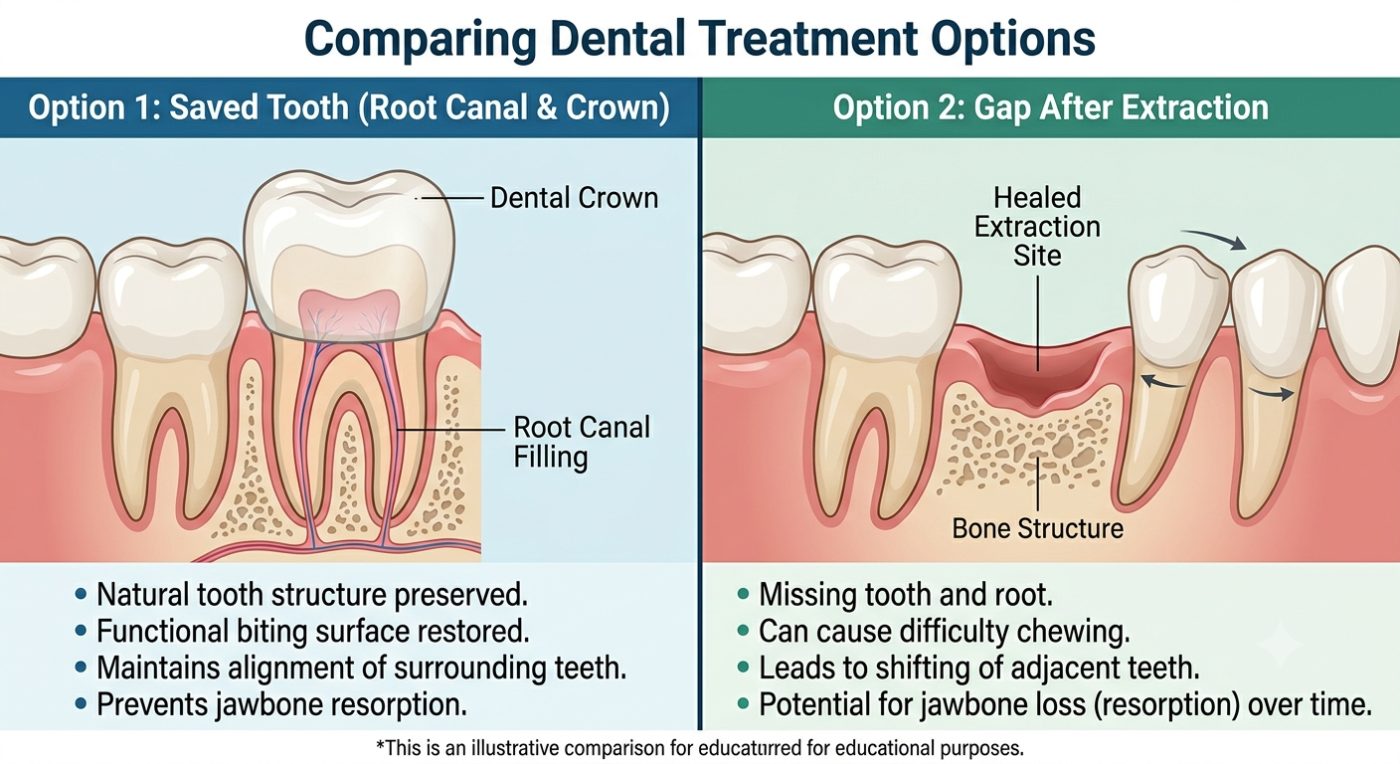
In short: Wherever possible, saving your natural tooth with a root canal is better than pulling it. Nothing works quite like a real tooth, and keeping it preserves your bite and jawbone. Extraction is cheaper upfront but leaves a gap that needs replacing. A dentist can advise when a tooth is too damaged to save.
When a tooth is badly infected or damaged, you often face a choice: a root canal to save it, or an extraction to remove it. As a general rule, saving the natural tooth is the better option — here’s why:
Keeping your tooth (root canal):
- Nothing functions quite like your own tooth for biting and chewing.
- It preserves the jawbone, which starts to shrink once a tooth is removed.
- It stops neighbouring teeth drifting into a gap and the bite changing.
- Once treated and crowned, a saved tooth can last many years, even a lifetime.
Removing the tooth (extraction):
- It’s cheaper and quicker upfront — but it leaves a gap.
- That gap ideally needs replacing (with an implant, bridge or denture) to avoid problems, which usually costs more overall than the root canal would have.
- Left unreplaced, tooth loss can lead to shifting teeth, bone loss and chewing difficulty.
So while extraction seems simpler, saving the tooth is generally healthier and better value in the long run.
That said, not every tooth can be saved — if it’s cracked too deeply, too broken down, or the surrounding bone is severely affected, extraction may be the sensible choice. A dentist will assess honestly and tell you whether the tooth is worth saving.
Book an appointment and we’ll advise whether a root canal can save your tooth or whether another option is better.