
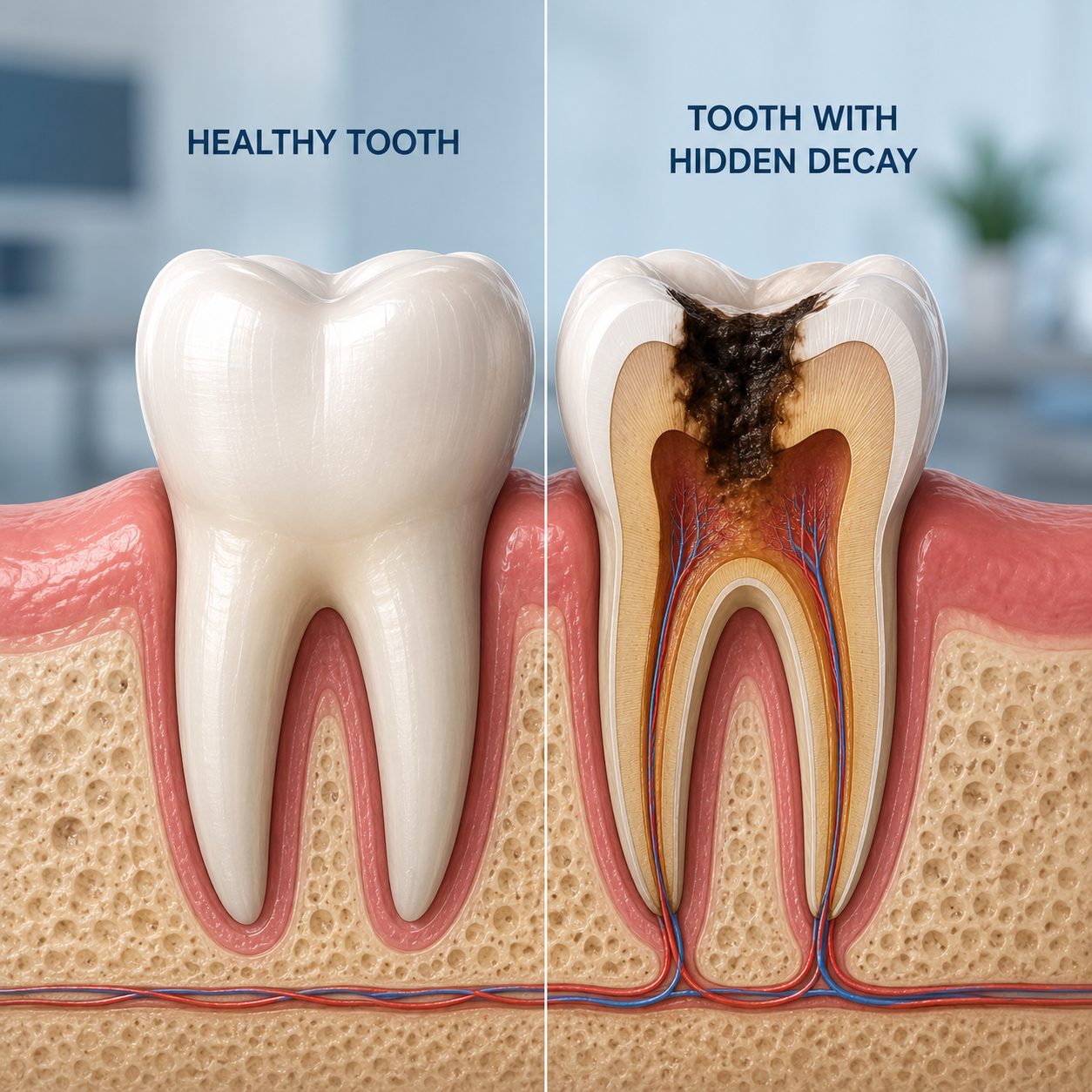
In short: Most dental problems are painless until they’re serious. Cavities, gum disease and even oral cancer can grow silently for months or years. A check-up spots them early, when treatment is small, cheap and quick. “Feeling fine” is the best time to visit — not a reason to skip.
Because most dental problems are silent until they are serious. Teeth and gums don’t have an early warning system you can rely on — cavities, gum disease and even oral cancer can grow for months or years without any pain at all. By the time you feel something, the damage is usually done.
A cavity, for example, starts on the outer enamel where there are no nerves, so it causes no discomfort. It only begins to hurt once it has tunnelled deep enough to reach the nerve inside — and at that point you may be looking at a root canal instead of a small filling. Gum disease is even quieter: it slowly destroys the bone holding your teeth in place, often with nothing more than mild bleeding as a clue, until teeth start to loosen.
A check-up lets a dentist see what you can’t. We look between and behind teeth, check old fillings, measure the gums, and use X-rays when needed to spot decay hidden between teeth or below the gumline. We also do a quick screen for oral cancer — a check that takes seconds but can be life-saving, especially in India where tobacco and gutka use is common.
“Feeling fine” is exactly the right time to visit, not a reason to skip. Prevention is cheaper, faster and far less uncomfortable than treatment. A twenty-minute check-up today can save you thousands of rupees and hours in the chair later.
If your teeth feel fine but it has been a while, that is the perfect time to book a check-up.